Muscadine
The Southern Grape That Outperforms
Modern “Superfoods”
Across the hot piney woods and sandy ridges of the American South, a thick-skinned wild grape has been quietly building one of the densest antioxidant profiles ever recorded in a fruit.
Most folks know the muscadine (Vitis rotundifolia) for jelly or backyard wine — but very few realize it often outranks blueberries, red grapes, and most marketed superfoods in the exact compounds researchers study for antioxidant and cellular protection.
Where European grapes evolved in mild Mediterranean climates, muscadines survived the American South by necessity — enduring extreme heat, drought, humidity, insects, fungal pressure, and poor soil.
Those stresses forced the plant to develop unusually high concentrations of ellagic acid, ellagitannins, anthocyanins, proanthocyanidins, quercetin, and resveratrol — the protective compounds modern research measures.
If the supermarket red grape is the “table fruit,” the muscadine is the fortress fruit — dense, dark, thick-skinned, and chemically loaded.
THE CHEMISTRY: WHY MUSCADINE CONSISTENTLY OUTPERFORMS STANDARD GRAPES
Scientific analyses of muscadine skins and seeds show concentrations of protective polyphenols that often exceed European Vitis vinifera grapes by 10x, 20x, and in some cases 40x depending on the compound.
Head-to-Head Comparison
(Based on multiple USDA and NCBI sources)
| Compound | Function | Standard Red Grapes (V. vinifera) | Muscadine (V. rotundifolia) |
|---|---|---|---|
| Ellagic Acid | Antioxidant; polyphenolic defense | Trace–Low | High — often dominant phenolic |
| Ellagitannins | Slow-release antioxidant reservoirs | Minimal | Very high; muscadine is one of the richest sources known |
| Anthocyanins | Pigmentation; oxidative stress defense | Moderate | High to extremely high |
| Proanthocyanidins (OPCs) | Cellular protection; tannins | Moderate | Very high (especially in seeds) |
| Resveratrol | Polyphenol researched for cellular effects | Low | Present, but overshadowed by stronger phenolics |
| Total Phenolic Content | Overall antioxidant density | Moderate | Very high — often several times higher |
Why this matters
- Most berries rely on anthocyanins alone for antioxidant power.
- Muscadines use multiple polyphenol families at once, creating a broader defensive profile.
- The thick skin and hardy seeds are the richest parts — exactly the plant tissues subjected to the most environmental stress.
In plain language:
If you’re comparing plants by the density of protective compounds, muscadine sits in its own category.
WHAT THE STUDIES SHOW ABOUT MUSCADINE
1. The Phenolic Powerhouse
A widely referenced study found ellagic acid is the dominant phenolic in muscadine skins,
with extremely high catechin and proanthocyanidin levels in seeds.
Source: https://pubmed.ncbi.nlm.nih.gov/12926904/
This is the opposite of European grapes, where resveratrol is the headline compound.
Muscadine is chemically richer, more complex, and far more robust.
2. Oxidative Stress & Antioxidant Enzymes (Research Model Study)
A peer-reviewed study using muscadine grape extract found:
- Significant protection against oxidative damage
- Increased activity of key antioxidant enzymes
Source: https://pmc.ncbi.nlm.nih.gov/articles/PMC9598776/
These observations highlight why muscadine stands out in the polyphenol world.
3. Human Safety & Tolerability
A Phase I human trial found muscadine grape extract to be:
- Safe
- Well tolerated
- Showing signals of improved physical well-being
Source: https://pmc.ncbi.nlm.nih.gov/articles/PMC8141001/
4. The Whole-Berry Advantage
A large review concluded that muscadine’s effects are due to synergy between its polyphenols, not resveratrol alone.
Source: https://www.sciencedirect.com/science/article/abs/pii/S1756464624001488
In other words: muscadine isn’t “a grape with resveratrol” —
it’s an entirely different biochemical system.
WHY THE TEXAS ENVIRONMENT MAKES MUSCADINE EVEN STRONGER
In the plant kingdom, stress builds chemistry.
Texas provides plenty:
- Intense UV exposure
- Long drought periods
- Sudden storms
- Fungal pressure
- Sandy soils with low nutrients
- Summer temperatures that push plants to their limits
Muscadine responds by building:
- Thicker skins
- More tannins
- Higher phenolic concentrations
- Darker pigmentation
Grapes that are pampered don’t need these defenses.
Grapes that survive Texas do.
This is why wild and stress-grown muscadines often surpass cultivated varieties in total polyphenol content.
REAL-WORLD BOTANICAL CONTEXT
Antioxidant Density
Most fruits feature one or two dominant antioxidant families.
Muscadine features many — stacked, layered, and synergistic.
Environmental Protection Chemistry
The compounds muscadines produce aren’t random:
- Ellagitannins defend against fungal pressure
- Anthocyanins protect from UV
- Proanthocyanidins protect seeds
- Skin polyphenols defend against insects and heat
This makes muscadine one of the best natural examples of stress-adaptive chemistry.
Flavor, Strength & Traditional Use
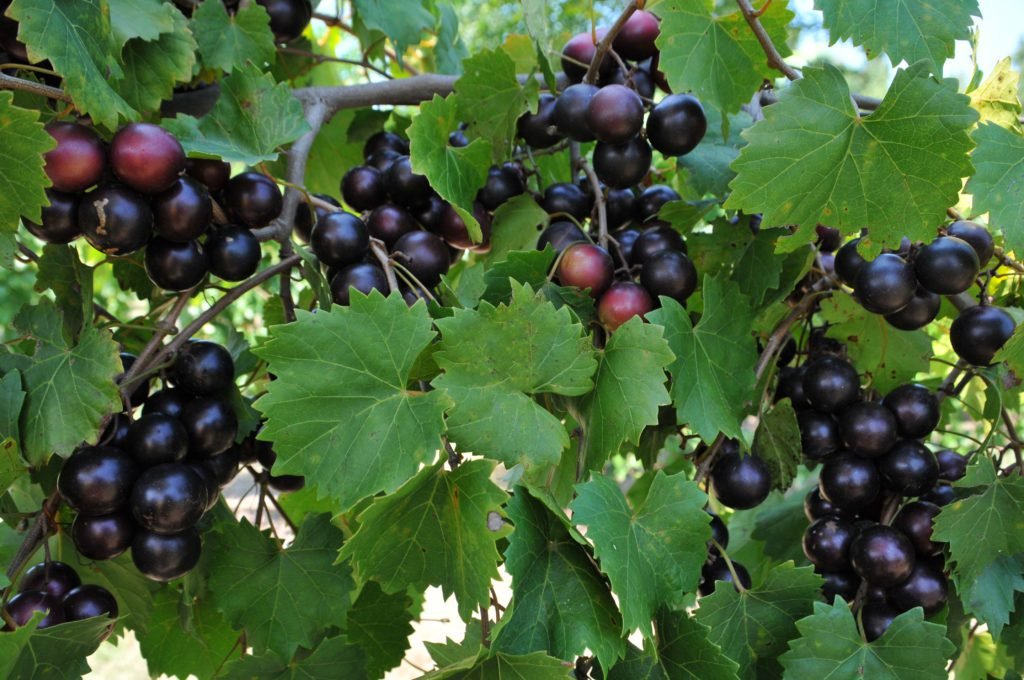
The thick skin, tannins, and deep purple color reflect the same compounds measured in research.
For generations, Southerners used muscadine in:
- Teas
- Syrups
- Wines
- Preserves
- Traditional tonics
Not because it was trendy — but because it worked hard in a landscape that demanded resilience.
THE BOTTOM LINE: WHY MUSCADINE IS OFTEN CALLED “THE STRONGEST GRAPE IN NORTH AMERICA”
Based on plant chemistry and environmental adaptation, muscadine shows:
- Polyphenol levels unmatched by standard grapes
- Exceptionally high ellagic acid and ellagitannins
- Dense antioxidant families working together
- Greater strength under environmental stress
- Thick skins and seeds packed with bioactive compounds
- Research interest far beyond that of table grapes
It doesn’t replace European grapes — it simply outpaces them in categories measured for chemical resilience.
Muscadine is what happens when a grape evolves to survive heat, storms, and hardship:
thicker skins, richer color, deeper chemistry, and antioxidant power that puts most “superfoods” to shame.
DISCLAIMER
This article summarizes published scientific research on plants only.
It does not describe or imply any effect of HK Naturals’ products.
For educational purposes only.